
Company9 min read
Why we rebranded: a new Thrifty AI for the age of artificial humans
 Thrifty AI Team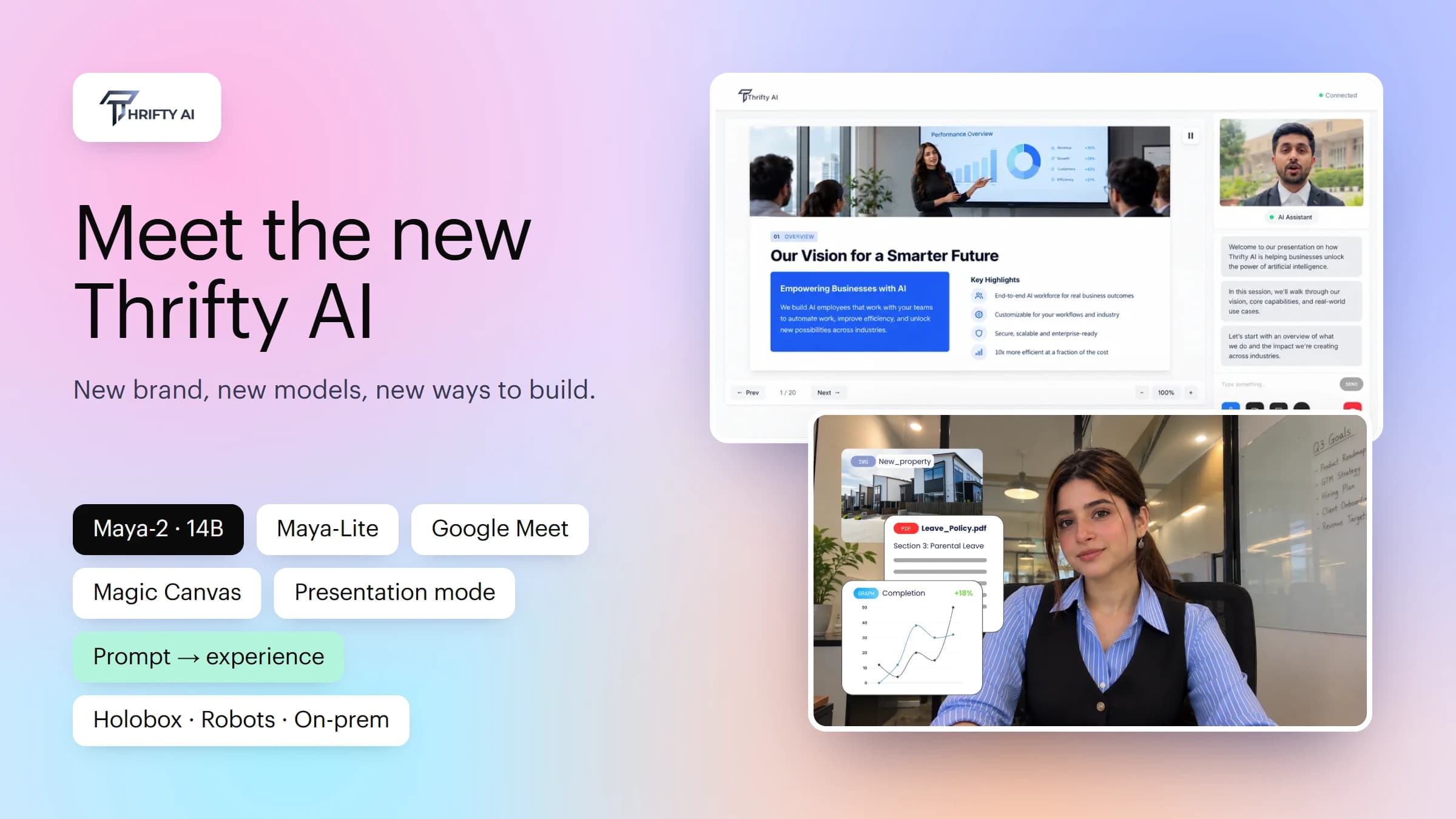
If you have visited thriftyai.com this week, you have noticed that it looks different. The colours, the type, the way we describe ourselves and most of the product pages are new. This post explains why we changed it, what we changed, and what shipped alongside the new site.
The short version: the brand we had was built for a company that made talking videos. The company we are now builds artificial humans, AI characters that see, hear and understand, and talk with you in real time. The website had to catch up with the product.
Where did Thrifty AI start?
Thrifty AI started with a phone call. During COVID, our co-founder Harsh Jha, about to fly from Pune to Ahmedabad, called his airline with one question: did he need a vaccination certificate to fly? He waited on hold for sixty minutes for an answer that took thirty seconds. Nobody was being unreasonable; there were simply too many people and not enough humans to answer them.
That hour became our mission: give AI a human face, so every person, in every language, at any hour, can be heard, understood and helped. Not to replace people, but to make sure nobody is left waiting on hold again.
Early on, the most practical way to put a face on AI was video: write a script, render a presenter, publish the clip. We got good at it, and our early brand reflected it. It talked about avatars, videos and content.
Why wasn't the old brand working any more?
Three things changed under our feet.
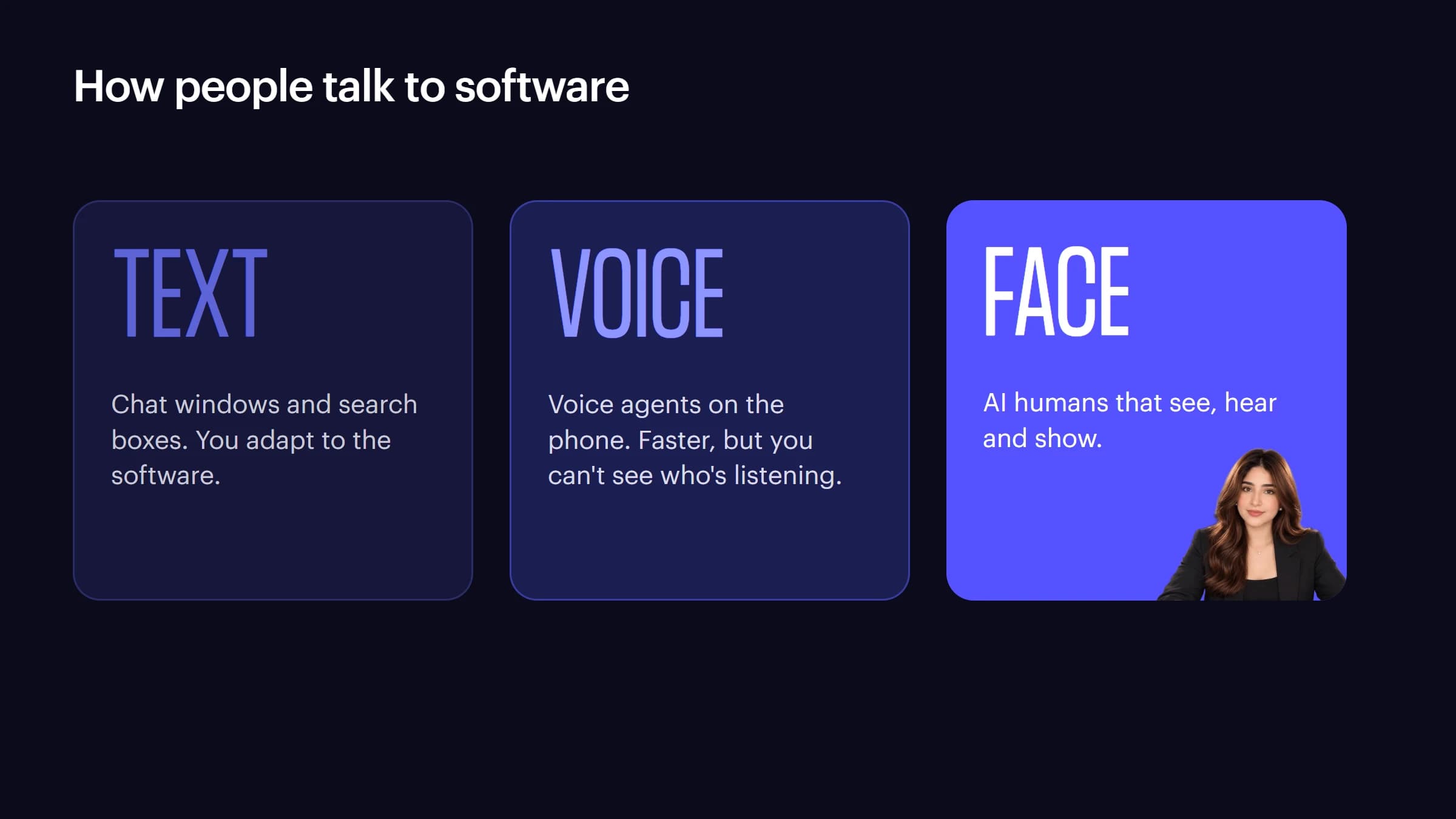
- The product became live. Customers stopped asking for videos and started asking for someone their users could talk to: a tutor at 10 pm, a concierge in a lobby, a support agent that can see your screen.
- "Avatar" undersold it. To most people an avatar is a cartoon profile picture or a pre-rendered spokesperson. Neither describes a face that listens, interrupts politely, pulls up a chart and books your appointment.
- Our buyers changed. Banks, hospitals, universities and government teams wanted to know where conversations go, whether it runs offline and what happens at minute twenty. A playful content brand didn't answer those questions.
What does the new brand stand for?
We wrote down four principles before anyone opened a design tool. Everything on the new site, from the headlines to the research pages, had to pass them.
| Principle | What it means in practice |
|---|---|
| Openly AI | Every Thrifty AI human says it is an AI. We build faces that are warm, not faces that pretend. |
| Live, not rendered | If it's on the site as interactive, it responds in real time. We publish start-up latency measured from first audio to first frame. |
| Consent first | Real people's likenesses are only used with documented consent. Stock and synthetic faces are clearly ours. |
| Runs where you need it | Cloud, your own VPC, fully air-gapped, or on a device in a hotel lobby. Deployment is a product feature, not a sales exception. |
What shipped with the new website?
A rebrand without new product is a coat of paint. This one came with the biggest release in our history.
Maya-2: our flagship model for more realism
Maya-2 is our new flagship face model: built in-house, and capable of full-body motion, not just a talking head. From a single image and a voice it produces a lip-synced stream that starts in 0.90 seconds and runs at 32 frames per second, comfortably above the 25 FPS threshold where motion looks live.
Realism lives in the details people notice without naming: how the shoulders move with a breath, how the eyes settle before a reply, how the face holds together at minute twenty. Maya-2 is built for exactly those details, and for streams that run as long as the conversation does.
Maya-Lite: the model that runs almost anywhere
Not every deployment has a data centre behind it. Maya-Lite is a compact talking-head model designed for a single GPU. Its Swift variant runs comfortably faster than real time on one consumer GPU, enough to serve many concurrent conversations from a kiosk or an edge box. It runs fully offline and air-gapped, which is what banks, hospitals and government sites have been asking for.
| Maya-2 | Maya-Lite | |
|---|---|---|
| Class | Flagship | Compact |
| Framing | Full body, portrait or landscape | Talking head |
| Speed | 32 FPS, 0.90 s start-up | Faster than real time on one consumer GPU (Swift) |
| Best for | Hero experiences, presenters, brand ambassadors | Kiosks, high-concurrency support, offline sites |
| Runs on | Our cloud or your GPUs | A single GPU, including fully air-gapped |
Prompt to an entire experience
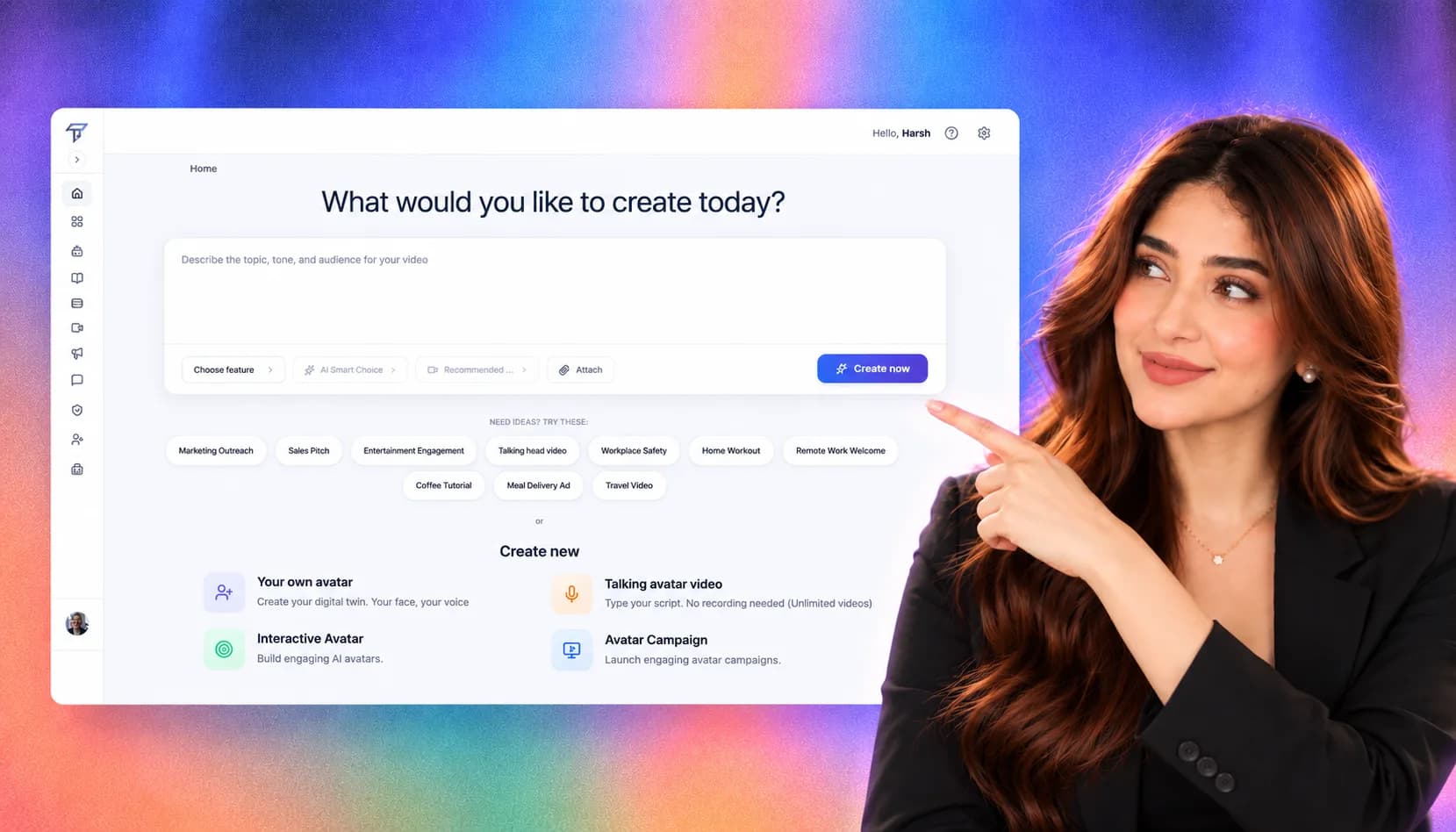
Thrifty Studios used to help you make an avatar. Now you describe what you want, and it builds the whole experience while you watch: the AI human, its knowledge, and the material it teaches or presents. One prompt can produce a full course with slides and lessons, a product demo, an onboarding guide or an event host, ready to share as a link or embed with a single script tag.
Magic Canvas
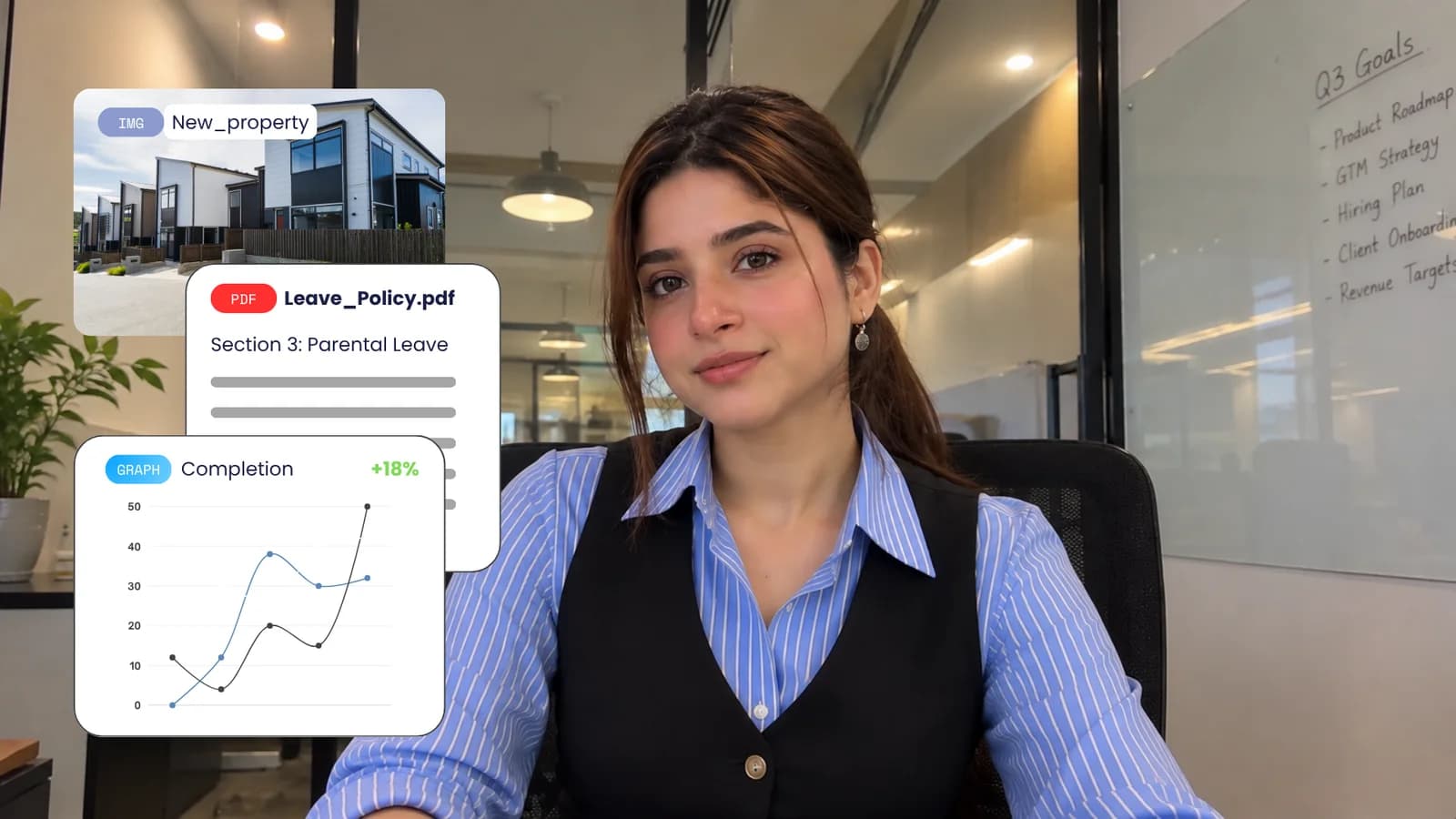
Conversations are better when you can see what is being discussed. Magic Canvas lets an AI human pull up images, PDFs and charts beside its face mid-conversation, and generate quizzes, videos and simple games on the fly. It decides when to show something and when to clear it, the way a good teacher uses a whiteboard.
Presentation mode
Upload a deck to the knowledge base and your AI human can present it: walk through it start to finish, or jump to the right slide when someone asks a question. Sales teams use it for always-on product tours; L&D teams use it for onboarding that answers back.
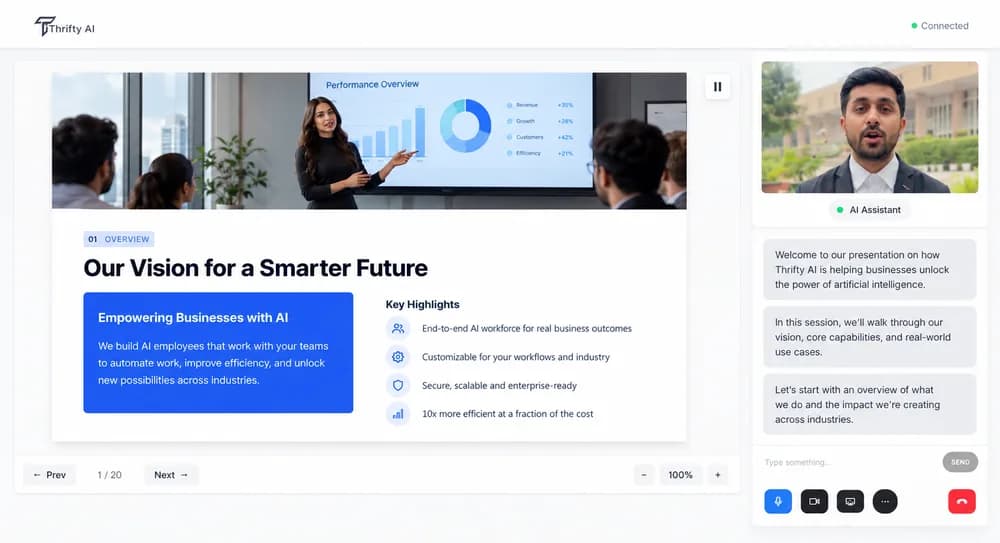
Google Meet (and Zoom)
Your AI human can now join meetings as an on-camera participant. Invite its email to the calendar event, or pass the meeting link through the API, and it joins, sees and hears the room, and takes part. It can even join a call already in progress. Think interview practice, product walkthroughs or a standing expert in your weekly review.
On-prem, holobox and robots
The same AI human now deploys to more places than ever: your website, a hosted page, a meeting, a kiosk, a holobox hologram display or a robot. For regulated teams, the entire stack, including speech, the language model, the voice and the face, runs on your own infrastructure. See self-hosting for the details.
| Where it runs | Typical use | What makes it work |
|---|---|---|
| Website or app | Support, sales, tutoring | One script tag or the API |
| Google Meet / Zoom | Interviews, demos, training | Joins as a participant with camera and mic |
| Kiosk | Lobbies, retail, citizen services | Maya-Lite on a single GPU, offline-capable |
| Holobox | Events, flagship stores, museums | Life-size hologram brand ambassador |
| Robot | Reception, guided tours, public spaces | The AI human becomes the robot's face and voice |
| On-prem / air-gapped | Banks, hospitals, government | Full stack on your servers, no internet needed |
What did we deliberately not change?
Our name, our team and our promise stayed. We are still Thrifty AI, still building from India for the world, and still obsessed with the moment someone stops waiting and starts getting help. We also kept our bias for showing over telling: almost every claim on the new site links to a live demo, a research page or a number you can test.
What's next?
- Smaller GPUs and lower latency for Maya-2, so the flagship experience reaches more deployments.
- Deeper partner integrations: we have new posts on pairing Thrifty with ElevenLabs Eleven v4, Cartesia Sonic, Claude Opus 5.5 and the latest GPT models.
- More honest comparisons, starting with Thrifty AI vs Anam and Thrifty AI vs Tavus.
Frequently asked questions
Why did Thrifty AI rebrand?
Thrifty AI's product moved from pre-rendered avatar videos to live artificial humans that hold real-time conversations. The new brand and website describe that product honestly: AI with a human face that is openly AI, live, consent-based and deployable anywhere, including on-prem.
What is Maya-2?
Maya-2 is Thrifty AI's in-house flagship face model. It generates full-body, lip-synced video from a single image and a voice, starts in 0.90 seconds and streams at 32 FPS.
What is Maya-Lite and where can it run?
Maya-Lite is a compact talking-head model designed for a single GPU. Its Swift variant runs faster than real time on one consumer GPU, and it can run fully offline and air-gapped on kiosks, edge boxes or private servers.
What is new in Thrifty Studios?
Prompt-to-experience creation, Magic Canvas for showing images, documents, charts and quizzes mid-conversation, Presentation mode for decks, and Google Meet and Zoom joining, plus deployment to kiosks, holoboxes, robots and on-prem servers.
Is Thrifty AI still the same company?
Yes. The name, founders and mission are unchanged. The rebrand reflects what the product has become, not a change of ownership or direction.
Want to try it yourself? Book a 30-minute demo or explore Thrifty Studios.

![Lavender thumbnail reading Give Eleven v4 a face, with the ElevenLabs logo and a Thrifty Studios label, and a black-and-white AI human on a cream cloud with a caption reading [warmly] Welcome back!](/_next/image?url=%2Fimages%2Fblog%2Fthrifty-elevenlabs-v4-logo.webp&w=3840&q=75)