Comparisons7 min read
Thrifty AI vs Tavus: real-time AI humans compared (2026)
 Thrifty AI Team
If you are shortlisting real-time AI human platforms, Tavus is almost certainly on the list. It's a strong product with serious research behind it. We obviously have a view, but we have tried to write the comparison we'd want to read: specific, sourced, and honest about where the other side wins. Vendor claims are labelled as such; please test both.
At a glance
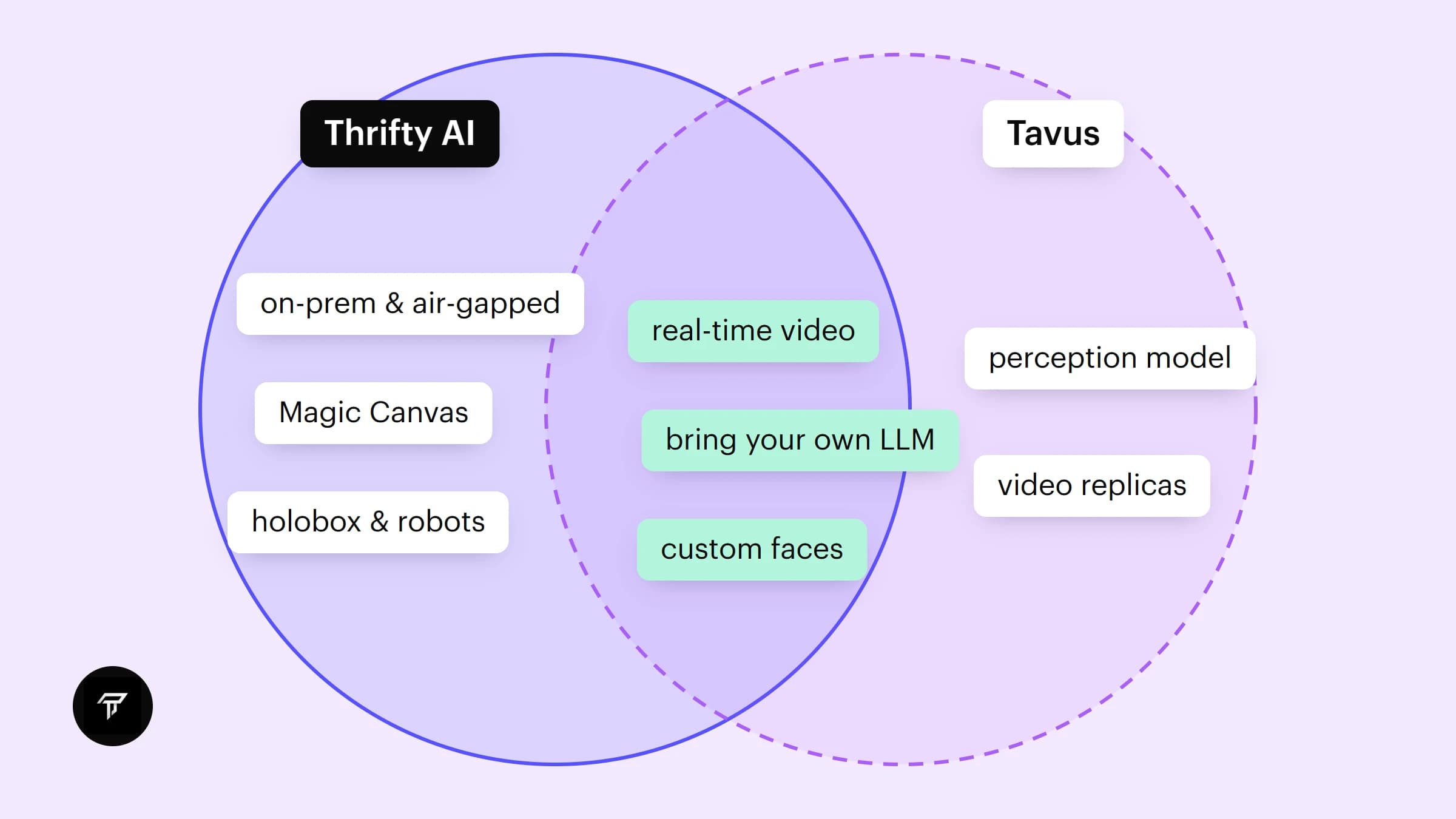
| Capability | Thrifty AI | Tavus |
|---|---|---|
| Core models | Maya-2 (flagship, full body) and Maya-Lite (compact, single GPU) | Phoenix-4.5 rendering, Raven-1 perception, Sparrow-2 turn-taking |
| Published face latency | Maya-2: 0.90 s start-up, first audio to first frame | Phoenix-4.5: 134 ms audio-to-video (per Tavus) |
| Languages | 70+ conversational languages | 42 spoken languages (per Tavus docs) |
| Custom face | One photo, or about a minute of video, or 100+ stock faces | Replica trained from a short video sample |
| Bring your own LLM | Yes: OpenAI, Anthropic, Gemini, Azure, Bedrock, private models | Yes |
| Voice providers | Thrifty voices, cloned voices, ElevenLabs, Cartesia | Tavus voices; see Tavus docs for third-party options |
| No-code builder | Thrifty Studios: one prompt to a full experience | Primarily API and developer portal |
| In-session visuals | Magic Canvas, Presentation mode, screen guidance | Not a core feature |
| Perception | Sees the user's screen; in meetings, sees and hears the room | Raven-1 reads expressions and tone in real time |
| Deployment | Cloud, your VPC, on-prem, air-gapped, kiosk, holobox, robot | Cloud API |
| Pricing model | Per-minute plans; from $0.04/min at scale; self-hosted licence | Per-minute CVI plans with a free tier |
How do the models differ?
Tavus has split the problem into specialist models. Phoenix renders the face; Tavus describes Phoenix-4.5 as its fastest and most expressive real-time rendering model, at 134 ms audio-to-video. Raven reads the user's expressions and tone in real time, and Sparrow handles turn-taking and interruptions. Tavus has also previewed Griffin, a single interaction model, with select testers.
Thrifty's approach centres on the face and the experience around it. Maya-2 is an in-house flagship model that generates full-body video from one image and a voice, starts in 0.90 seconds and streams at 32 FPS. Maya-Lite is a compact model that runs faster than real time on a single GPU, and fully offline.
Where can each one run?
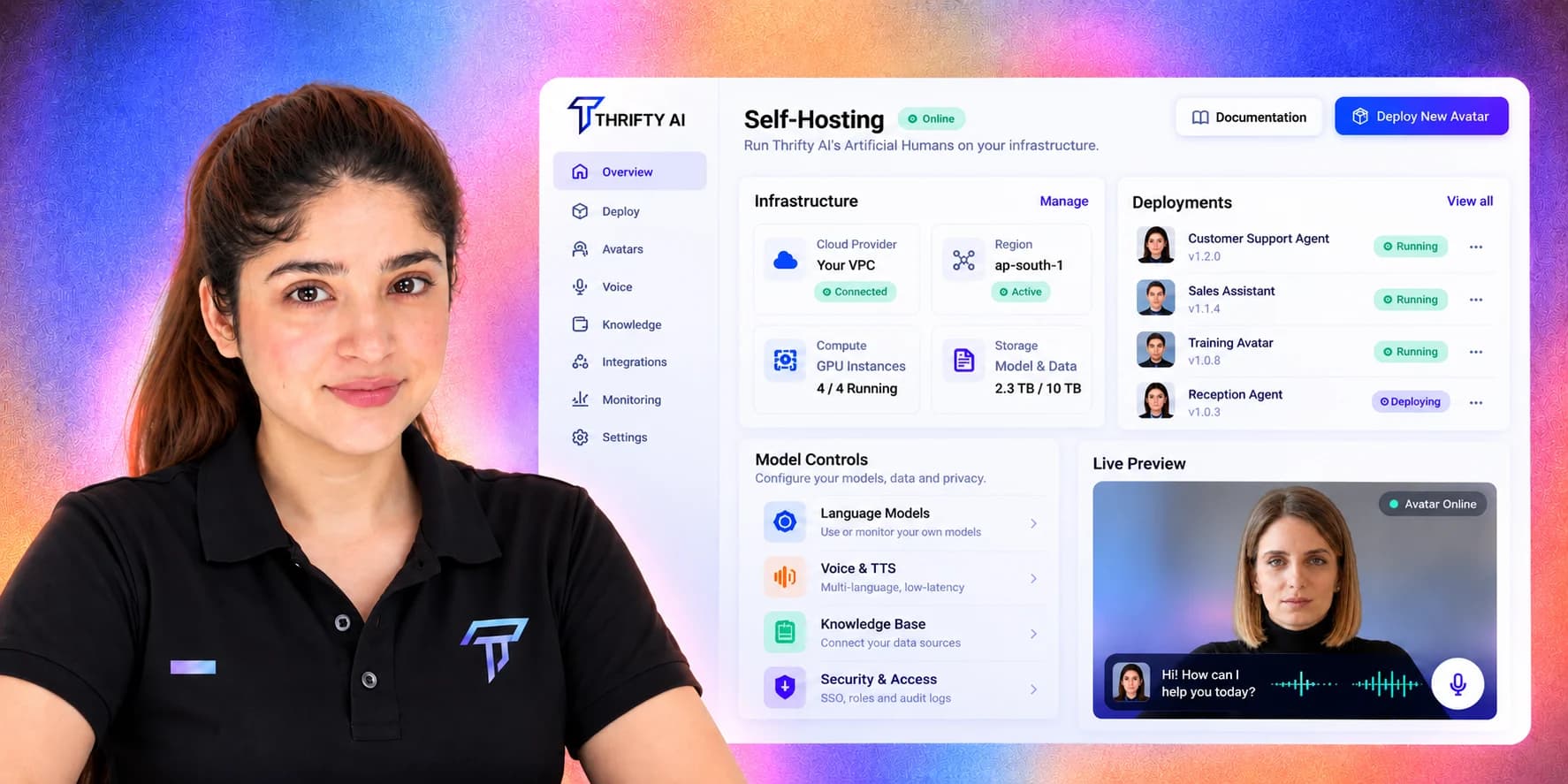
This is the biggest practical difference. Tavus is delivered as a cloud API. Thrifty runs in our cloud, in your own VPC, fully on-prem and air-gapped, and on physical devices: kiosks, holobox hologram displays and robots. For banks, hospitals and government teams, the ability to run speech, the language model, the voice and the face inside their own network often decides the shortlist.
How do you build with each?
Tavus is built for developers: you create replicas and personas, start conversations through the API and embed the conversational video interface in your app. That is a great fit for product teams who want full control in code.
Thrifty offers a developer API too, but most customers start in Thrifty Studios. You describe what you want and Studios builds the AI human, its knowledge and its material, such as a course with slides or a product demo. L&D, sales and support teams can ship without waiting for engineering.
What can a session show, not just say?
A conversation often needs more than a face. Thrifty AI humans can pull up images, PDFs and charts with Magic Canvas, present a deck in Presentation mode, generate quizzes mid-lesson and guide users through their own screen. Tavus focuses on the face-to-face conversation itself, with perception that reads the user's expressions.
How does pricing compare?
Both charge per minute of conversation, both have a free tier, and both offer enterprise agreements, so headline rates matter less than your session length, concurrency and where the stack runs. Thrifty publishes plans on its pricing page, reaches $0.04 per minute at enterprise scale, and offers a self-hosted option priced as an annual platform licence plus streaming minutes, with your own AI providers at no markup. Check Tavus's pricing page for its current plans.
Where does Thrifty AI win?
- Deployment range: on-prem, air-gapped, kiosks, holobox and robots, as well as cloud.
- No-code building: prompt to a full experience in Thrifty Studios.
- Showing, not just telling: Magic Canvas, Presentation mode and screen guidance.
- Full-body realism with Maya-2, and single-GPU efficiency with Maya-Lite.
- Language breadth, including Indian languages for public-sector deployments.
When is Tavus the better choice?
- You want a mature, API-first conversational video platform and your team prefers to build everything in code.
- Perception, the AI reading the user's facial expressions and tone, is central to your use case.
- You need a replica trained from video of a specific person and Tavus's replica pipeline fits your workflow.
- Your product is already built on Tavus and the switching cost outweighs the gains.
Which should you choose for your use case?
| Use case | Leaning | Why |
|---|---|---|
| Bank, hospital or government | Thrifty AI | On-prem and air-gapped deployment |
| Kiosk, lobby or event | Thrifty AI | Maya-Lite on device, holobox and offline operation |
| L&D courses and roleplay | Thrifty AI | Prompt-to-course, Magic Canvas, scoring |
| Developer-built consumer app | Either; Tavus if you want perception | Both have APIs; compare in your stack |
| Emotion-aware companion | Tavus is worth a close look | Raven perception is a core feature |
Frequently asked questions
What is the difference between Thrifty AI and Tavus?
Both offer real-time AI humans. Tavus is an API-first platform built on its Phoenix, Raven and Sparrow models. Thrifty AI pairs its Maya-2 and Maya-Lite models with a no-code studio, in-session visuals like Magic Canvas, and deployment to cloud, on-prem, air-gapped sites, kiosks, holoboxes and robots.
Can Thrifty AI run on-premises?
Yes. Thrifty can run the full AI human stack, including speech, the language model, the voice and the face, on your own servers, including fully air-gapped networks.
Which is faster, Thrifty AI or Tavus?
They publish different measurements: Tavus reports 134 ms audio-to-video for Phoenix-4.5, and Thrifty reports a 0.90 s start-up from first audio to first frame for Maya-2. Test both end to end with the same LLM and network.
How many languages do Thrifty AI and Tavus support?
Thrifty AI humans converse in 70+ languages. Tavus's documentation lists 42 spoken languages at the time of writing.
Is Tavus better for developers?
Tavus is strongly developer-focused. Thrifty also offers a developer API, and adds Thrifty Studios for teams who want to build without code.
Also comparing Anam? Read Thrifty AI vs Anam.