Comparisons7 min read
Thrifty AI vs Anam: which real-time AI human platform fits your team? (2026)
 Thrifty AI Team
Anam has built a well-liked product, particularly with developers, and publishes a lot about real-time avatars. If you are choosing between Anam and Thrifty AI, the decision usually comes down to two questions: who will build the experience, and where does it need to run? This comparison is our honest view. We note vendor claims as claims, and we're clear about where Anam is the better fit.
At a glance
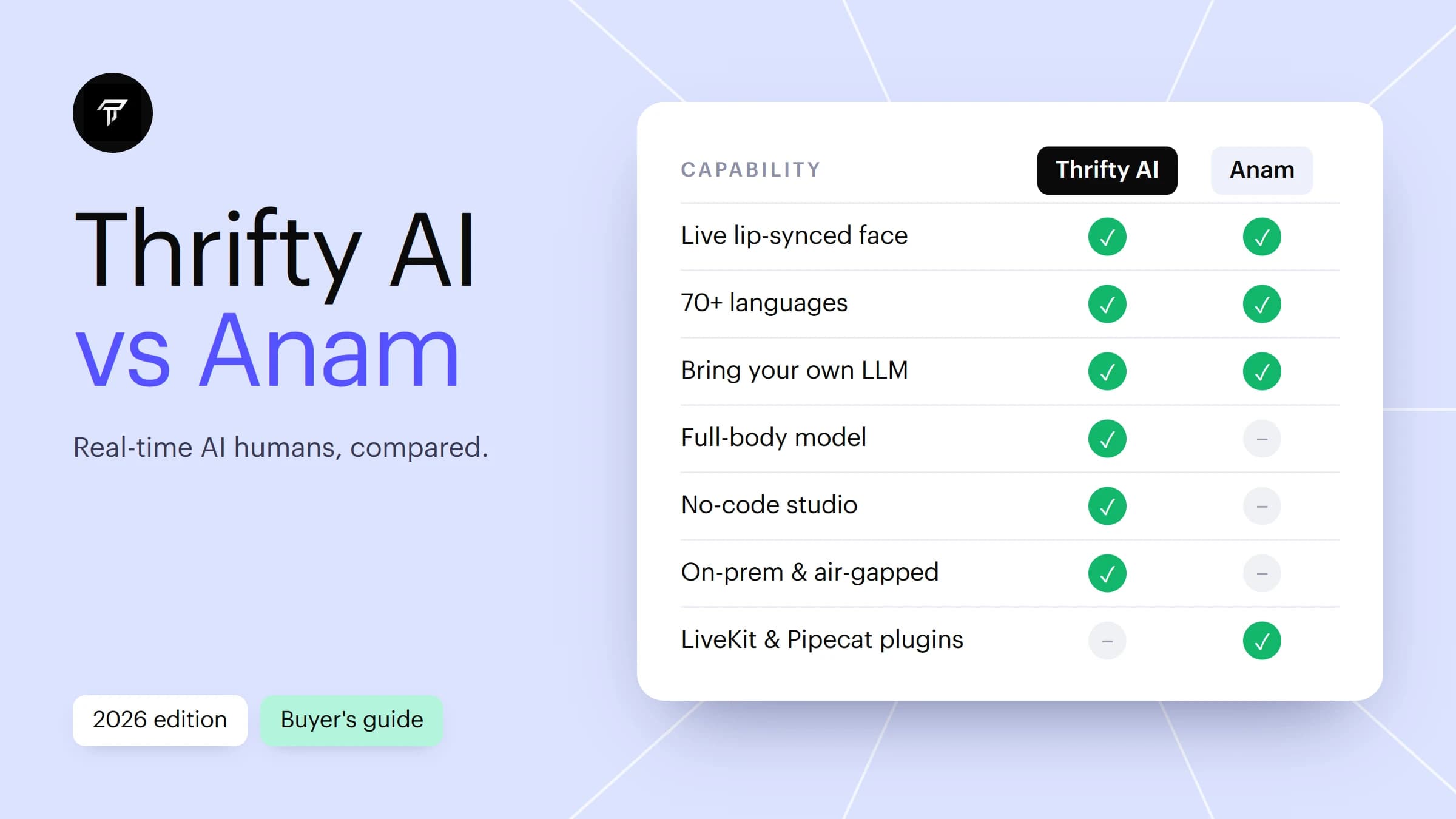
| Capability | Thrifty AI | Anam |
|---|---|---|
| Face models | Maya-2 (flagship, full body); Maya-Lite (compact, single GPU) | Cara 4, talking head, landscape or portrait |
| Published latency | Maya-2: 0.90 s start-up, first audio to first frame | About 150 ms server-side avatar generation once a session is running (per Anam) |
| Languages | 70+ | 70+ |
| Custom face | One photo, about a minute of video, or 100+ stock faces | Custom avatar from a single image |
| LLM, STT and voice | Bring your own: OpenAI, Anthropic, Gemini, ElevenLabs, Cartesia, Deepgram | Bring your own: OpenAI, Claude, Gemini, Cartesia, Deepgram and others |
| Building | Thrifty Studios (no-code, prompt to experience) plus an API | Anam Lab plus JavaScript and Python SDKs |
| Framework plugins | API and WebRTC; works alongside agent frameworks | First-class LiveKit and Pipecat plugins |
| In-session visuals | Magic Canvas, Presentation mode, screen guidance | Not a core feature |
| Deployment | Cloud, VPC, on-prem, air-gapped, kiosk, holobox, robot | Cloud |
| Data controls | Zero data retention mode; full self-hosting when data can't leave your network | SOC 2 Type II, zero data retention, regional data residency |
Who is each platform built for?
Anam's centre of gravity is the developer. You define a persona (face, voice, LLM and system prompt), create a session token and stream the avatar into your app with its SDK, or drop it into a LiveKit or Pipecat agent with a plugin. If your team already runs a voice agent framework, that is a short path to a face.
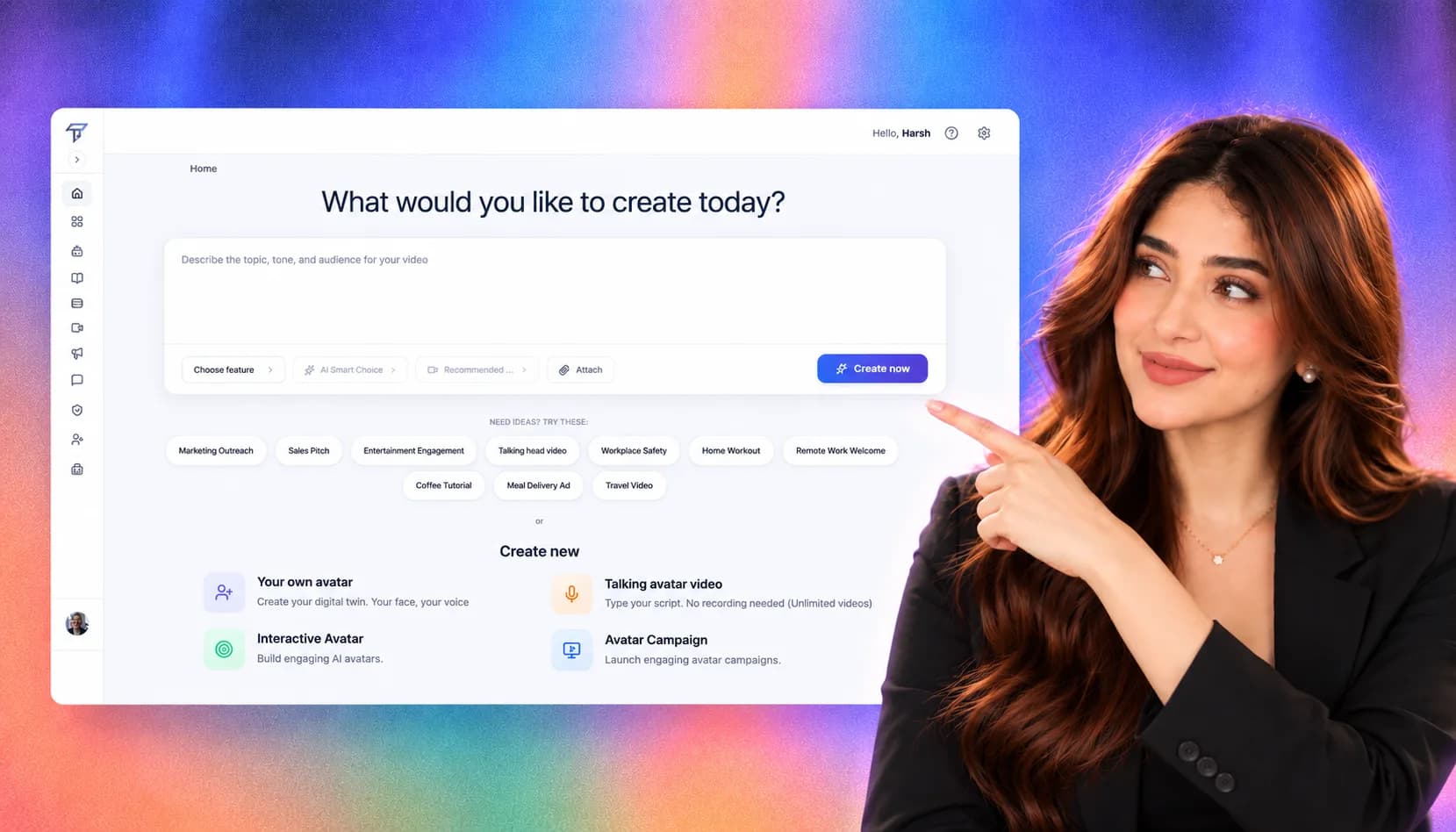
Thrifty's centre of gravity is the experience. Many of the people who build on Thrifty are L&D managers, sales leaders, marketers and support operations teams. In Thrifty Studios they describe what they want and Studios builds it: the AI human, its knowledge, and the material it presents or teaches. Developers still get an API, but they are not a prerequisite.
How do the face models compare?
Anam's Cara 4 is a talking-head model with improved lip sync, expressivity and identity preservation over its predecessor, and Anam's Director Notes let you guide its emotional delivery. Anam reports about 150 ms for server-side avatar generation once a session is running, and is careful to note that this is one stage of the pipeline.
Thrifty offers two models for two jobs. Maya-2 is our flagship full-body model for experiences where realism carries the brand: presenters, ambassadors and holobox hosts. Maya-Lite is a compact talking-head model that runs on a single GPU, faster than real time, for kiosks, high-concurrency support and offline sites.
What can the AI human show during a conversation?
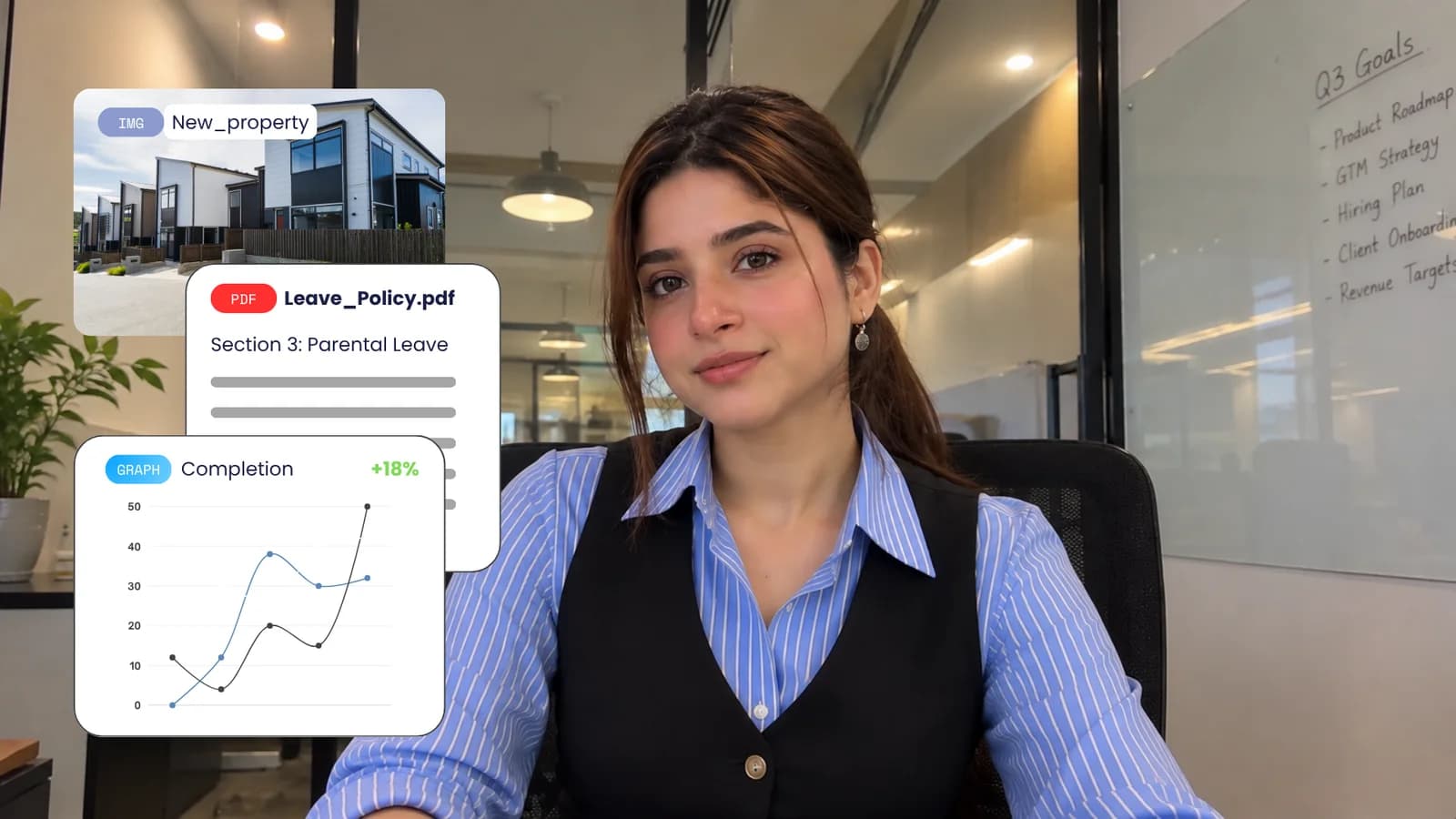
This is where the products diverge most. Thrifty AI humans can open images, PDFs and charts beside their face with Magic Canvas, generate quizzes and simple games, present a slide deck from the knowledge base in Presentation mode, and guide users through their own screen. For training, sales demos and onboarding, the ability to show and tell in the same conversation is often the reason teams choose Thrifty.
Where can each one run?
Anam is delivered as a cloud service with SOC 2 Type II, zero data retention and regional data residency. Thrifty runs in our cloud, in your VPC, fully on-prem or air-gapped, and on physical devices including kiosks, holobox hologram displays and robots. If conversations can't leave your building, or the experience lives in a lobby rather than a browser tab, that difference settles it.
How does pricing compare?
Both price per streamed minute with a free tier, monthly plans and enterprise agreements. Anam publishes per-minute plans on its pricing page. Thrifty's plans reach $0.04 per minute at enterprise scale, and the self-hosted option is an annual platform licence plus streaming minutes, with your own AI providers at no markup. For long sessions such as tutoring or roleplay, model your real session lengths and concurrency, because they drive cost more than headline rates.
Where does Thrifty AI win?
- Teams who want to build without code, from a single prompt.
- Experiences that need to show content: Magic Canvas, Presentation mode, screen guidance.
- Full-body realism with Maya-2.
- On-prem, air-gapped and physical deployments: kiosks, holobox and robots.
- Joining Google Meet and Zoom calls as an on-camera participant.
When is Anam the better choice?
- Your team is building in code and already runs LiveKit or Pipecat; Anam's plugins are a fast path.
- You want a lightweight talking-head layer on top of an existing voice agent and nothing else.
- You prefer to self-serve from a developer lab with transparent per-minute plans from day one.
| Use case | Leaning | Why |
|---|---|---|
| Corporate training and roleplay | Thrifty AI | Prompt-to-course, Magic Canvas, scoring |
| Face for an existing LiveKit or Pipecat agent | Anam | First-class plugins |
| Hotel lobby, retail floor or event | Thrifty AI | Kiosk, holobox and offline operation |
| Regulated industries | Thrifty AI | On-prem and air-gapped deployment |
| Developer prototype in a weekend | Either | Both have free tiers; try both |
Frequently asked questions
What is the difference between Thrifty AI and Anam?
Anam is a developer-first real-time avatar API built on its Cara 4 model, with SDKs and LiveKit and Pipecat plugins. Thrifty AI adds a no-code studio, in-session visuals such as Magic Canvas and Presentation mode, full-body realism with Maya-2, and deployment to on-prem, air-gapped sites, kiosks, holoboxes and robots.
Does Anam or Thrifty AI support more languages?
Both list 70+ languages. Test each language you plan to launch with native speakers, because voice quality varies by language.
Can I bring my own LLM to Thrifty AI and Anam?
Yes. Both let you bring your own LLM, speech recognition and voice providers, including OpenAI, Anthropic Claude, Gemini, Cartesia and Deepgram.
Can Anam run on-premises?
Anam is offered as a cloud service with zero data retention and regional data residency. Thrifty AI can run the full stack on your own servers, including fully air-gapped networks.
Which is better for kiosks and events?
Thrifty AI, because Maya-Lite runs on a single GPU and the full AI human can operate offline on kiosks, holobox displays and robots.
Also comparing Tavus? Read Thrifty AI vs Tavus.