Partnerships6 min read
Thrifty AI with GPT-6 and gpt-realtime-2.1: cascaded vs speech-to-speech AI humans
 Thrifty AI Research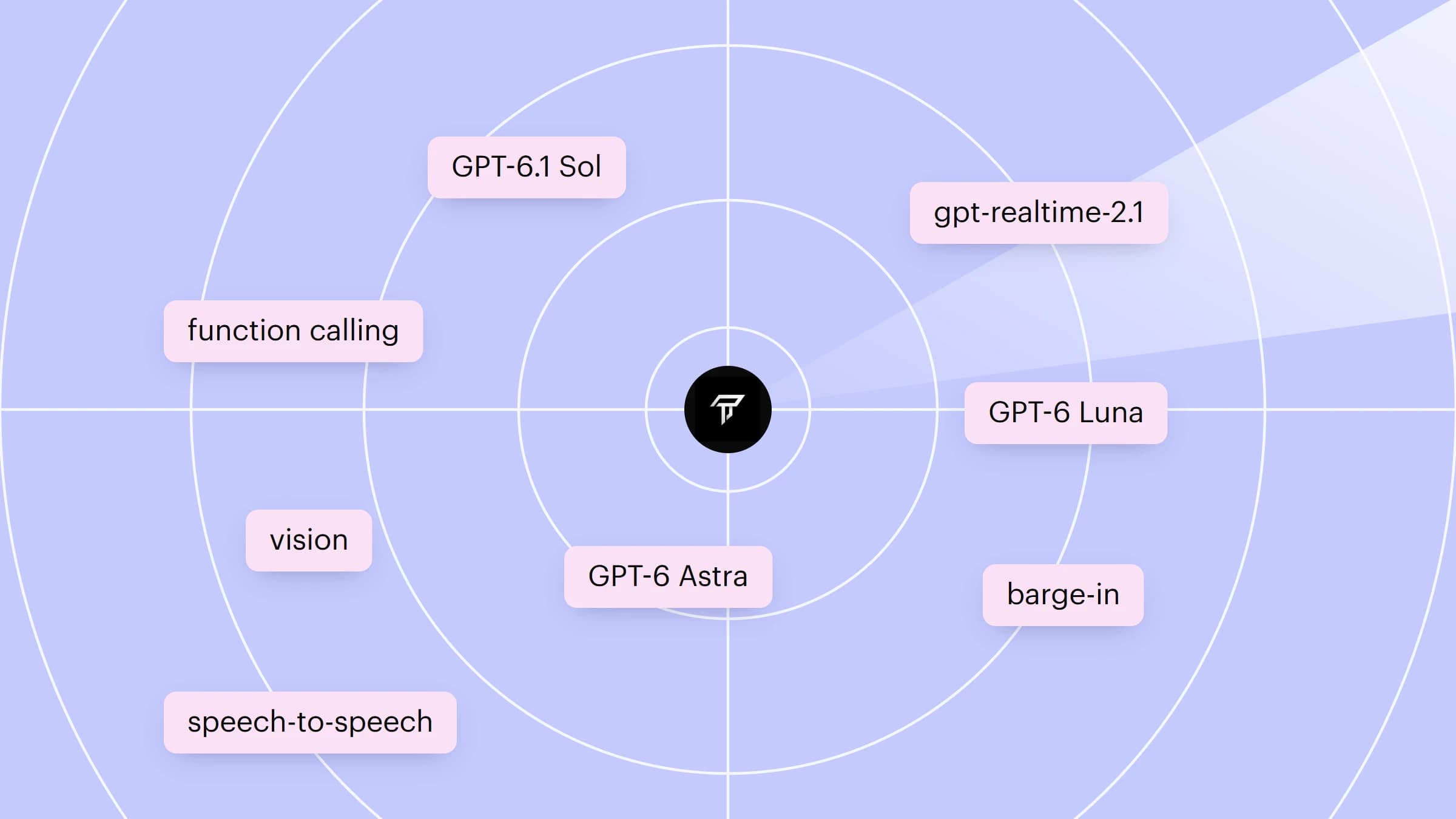
The question we hear most from teams building on OpenAI is not "which GPT is best?" but "should our AI human think in text or in speech?" OpenAI's 2026 releases make both options genuinely good, and they behave differently once you put a face on them. This post walks through the line-up, the two architectures and the decision we help customers make.
What are OpenAI's latest models?
| Model | API ID | Price per 1M tokens (in / out) | Notes |
|---|---|---|---|
| GPT-6 Astra | gpt-6-astra | $10 / $50 | OpenAI's most capable model; 1.05M context; reasoning levels from low to max |
| GPT-6.1 Sol | gpt-6.1-sol | $2 / $10 | Launched at DevDay on 29 September; near-Astra quality at about a fifth of the price |
| GPT-6 Luna | gpt-6-luna | $0.10 / $0.50 | Most efficient model, for high-volume work |
| gpt-realtime-2.1 | gpt-realtime-2.1 | Audio $32 / $64; text $4 / $24 | Speech-to-speech with function calling, image input and a 128K context |
OpenAI has also launched GPT-Live 1 in ChatGPT, a full-duplex voice model that listens and speaks at the same time. At launch OpenAI described developer API access as planned; we'll write about it once it is generally available to build on.
What is a cascaded AI human?
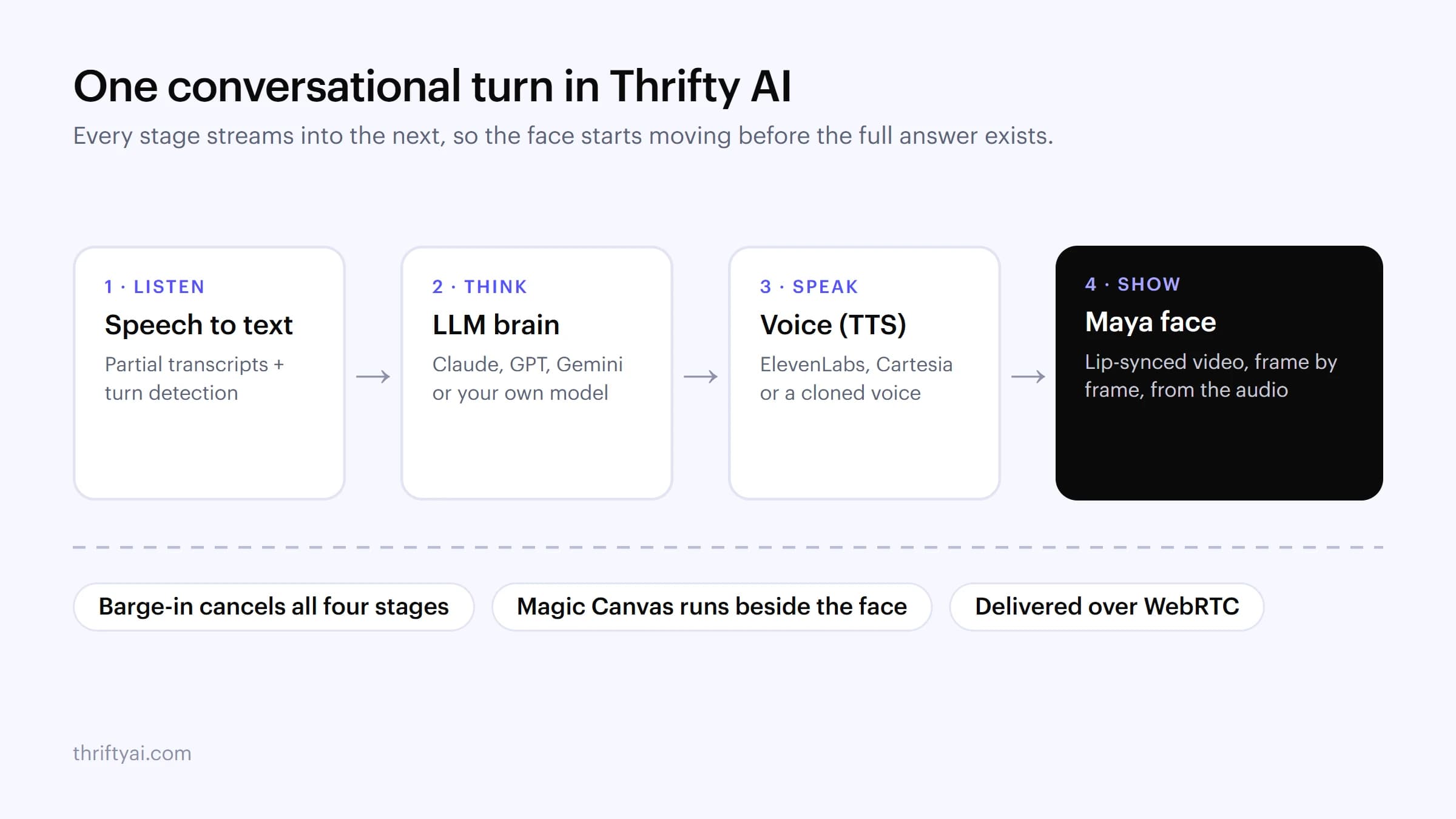
In a cascaded pipeline, each job has its own specialist. Speech recognition turns the user's words into text, a text model such as GPT-6.1 Sol decides what to say and do, a voice model speaks it, and the Maya face animates from that audio. Every stage streams into the next, so the face starts moving before the full answer is written.
What is a speech-to-speech AI human?
In a speech-to-speech setup, a single realtime model hears the user's audio and replies with audio directly. There is no separate transcription or voice step. Thrifty takes the model's audio output and drives the face from it, exactly as it would with any other voice.
Because the model hears tone and speaks with its own prosody, conversations tend to sound more natural: it can respond to hesitation, laugh at the right moment and mirror the user's energy. The trade-off is control. You get the realtime model's voices, and grounding and guardrails live inside one model instead of being enforced at each stage.
| Cascaded (STT → GPT-6.x → TTS → face) | Speech-to-speech (gpt-realtime-2.1 → face) | |
|---|---|---|
| Voice choice | Any voice: ElevenLabs, Cartesia, cloned, Thrifty | The realtime model's voices |
| Naturalness | Very good with expressive TTS | Excellent: the model hears and speaks tone |
| Control and grounding | Inspect and filter text between every stage | Fewer checkpoints; rely on the model's instructions and tools |
| Transcripts and analytics | Native: text exists at every step | Available, but generated alongside the audio |
| Mix and match | Different vendors per stage, or self-hosted parts | One vendor for listening, thinking and speaking |
| Cost shape | Text tokens plus STT and TTS minutes | Audio tokens, which cost more per token than text |
| On-prem options | Speech, voice and face can run locally | The realtime model runs in OpenAI's or Azure's cloud |
How should you choose?
We use four questions with customers:
- Does the brand need a specific voice? If you have a cloned spokesperson, a licensed voice or an ElevenLabs or Cartesia voice your customers already know, go cascaded.
- How regulated is the content? If every answer must be checked against approved material, cascaded gives you a text checkpoint before anything is spoken.
- Where must the data live? If speech recognition or the voice must run on your servers, cascaded lets you self-host those stages while still calling GPT for reasoning.
- Is the conversation the product? For language practice, coaching and companion-style experiences, where natural back-and-forth matters most, speech-to-speech often wins.
| Use case | Our usual starting point | Why |
|---|---|---|
| Customer support | Cascaded with GPT-6.1 Sol | Grounding, transcripts and a brand voice |
| Language tutor | Speech-to-speech | Pronunciation and tone are the lesson |
| Sales roleplay | Either; speech-to-speech for realism | Pressure and interruptions feel more real |
| Bank or hospital | Cascaded, partly self-hosted | Data residency and content controls |
| High-volume FAQ kiosk | Cascaded with GPT-6 Luna and Maya-Lite | Lowest cost per minute |
| Executive briefing agent | Cascaded with GPT-6 Astra for hard questions | Depth over speed, with a fast model for small talk |
Which GPT text model for which AI human?
For the cascaded path, the routing logic from our Claude Opus 5.5 post applies equally to OpenAI. Most personas run well on GPT-6.1 Sol as the default brain. Use GPT-6 Luna for very high-volume, simple flows. Reserve GPT-6 Astra for turns that need deep reasoning, and keep a fast model talking while it works.
How do you connect OpenAI models in Thrifty?
- Cascaded: choose "bring your own LLM", connect OpenAI directly or through Azure OpenAI, pick the model per persona, and choose any voice.
- Speech-to-speech: through the Developer API or a custom build, a realtime model becomes the conversational engine while Thrifty handles the WebRTC session, the face and the deployment channels.
- Either way, the AI human keeps its Thrifty features: Magic Canvas, Presentation mode, knowledge base, Google Meet joining and analytics.
Frequently asked questions
Does Thrifty AI work with OpenAI's GPT models?
Yes. Thrifty supports OpenAI and Azure OpenAI models as the LLM brain of an AI human. Most deployments use a cascaded pipeline; speech-to-speech builds are available through the Developer API and custom solutions.
What is the difference between cascaded and speech-to-speech?
Cascaded AI humans use separate speech recognition, a text LLM and a voice model, then animate the face from the voice. Speech-to-speech AI humans use one realtime model that hears and speaks audio directly, and the face is driven from its output.
Which is better for an AI human, GPT-6.1 Sol or gpt-realtime-2.1?
Use GPT-6.1 Sol in a cascaded pipeline when you need a specific voice, strict grounding or self-hosted parts. Use gpt-realtime-2.1 when natural, emotionally responsive conversation matters most and one cloud vendor is acceptable.
Can I use my own voice with a realtime model?
Not directly; speech-to-speech models speak in their own voices. To use a cloned or third-party voice such as ElevenLabs or Cartesia, use the cascaded architecture.
Is GPT-Live available for AI humans?
OpenAI launched GPT-Live 1 in ChatGPT and described API access as planned. We will support it once it is generally available to developers.
![Lavender thumbnail reading Give Eleven v4 a face, with the ElevenLabs logo and a Thrifty Studios label, and a black-and-white AI human on a cream cloud with a caption reading [warmly] Welcome back!](/_next/image?url=%2Fimages%2Fblog%2Fthrifty-elevenlabs-v4-logo.webp&w=3840&q=75)