Partnerships7 min read
Thrifty AI × Claude Opus 5.5: giving a long-horizon agent a face that talks while it works
 Thrifty AI Engineering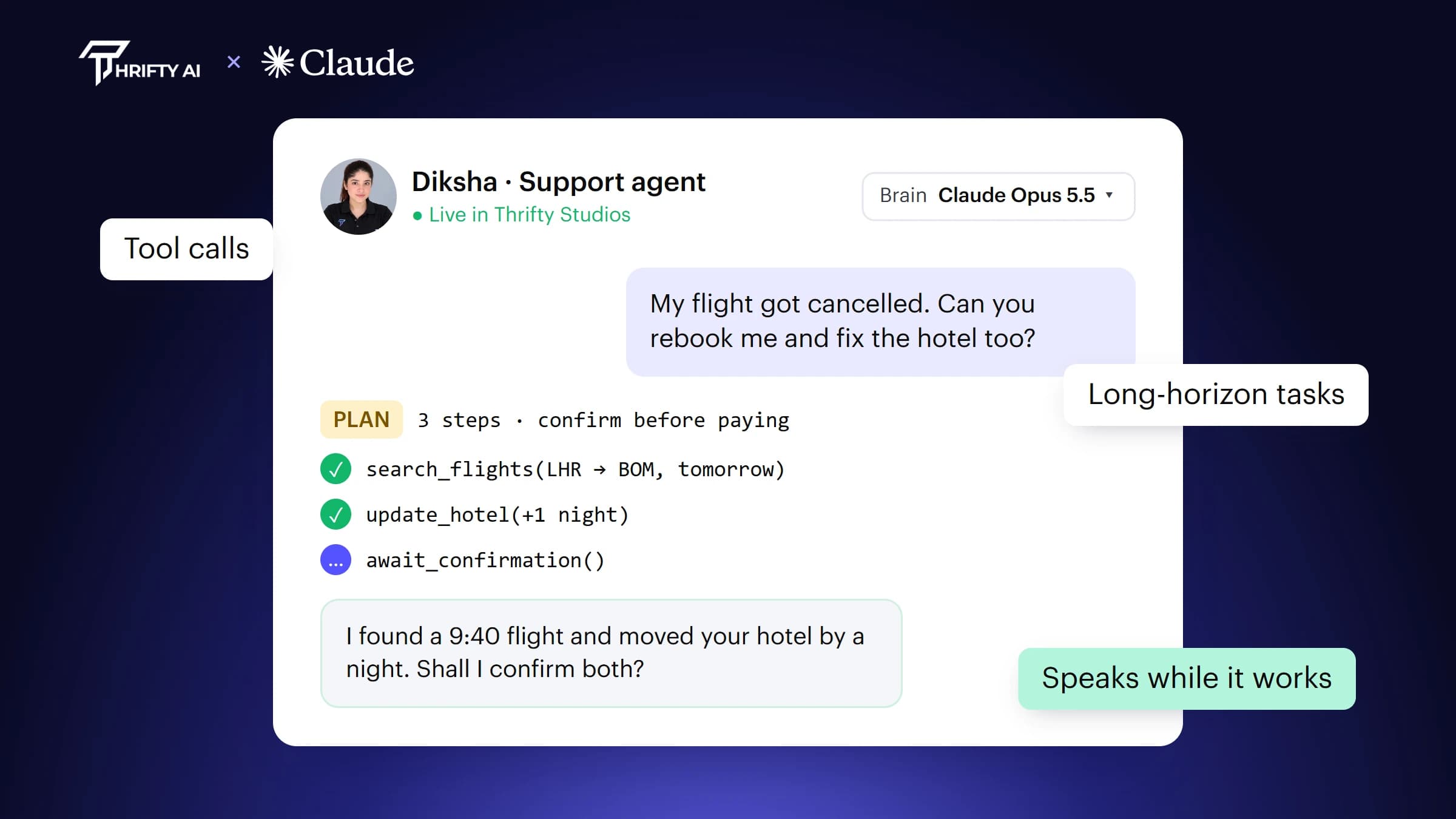
AI humans used to be judged on how well they talk. Increasingly, they are judged on what they get done: rebooking a flight, fixing a billing error, scheduling a follow-up, filling a form. That shift puts more weight on the brain behind the face. This post covers how we use Claude Opus 5.5 in Thrifty AI, and the design pattern that stops a powerful model from making a conversation feel slow.
What is Claude Opus 5.5?
Claude Opus 5.5 (model ID claude-opus-5-5) is the first model in Anthropic's Claude 5.5 family. Anthropic positions it as performing at the level of Claude Fable 5.1 on most work while leading on agentic coding, computer use and knowledge work. It is priced at $4 per million input tokens and $20 per million output tokens, with cached reads at $0.20, and a Fast mode of up to 2.5× speed at $8 / $40. Anthropic also offers zero data retention, and the model is available through AWS, Google Cloud and Azure as well as Anthropic's own API.
One detail matters a lot for voice: on Opus 5.5, extended thinking can no longer be switched off. Thinking makes the model better at hard tasks, but it adds time before the first word. For a live AI human, that changes how you wire it in.
| Model | Price per 1M tokens (in / out) | What Anthropic emphasises | Best AI human job |
|---|---|---|---|
| Claude Haiku 5.5 | $0.10 / $0.50 (prompts up to 100k) | Fastest standard-speed model, adjustable effort | The voice in the room: greetings, FAQs, small talk, triage |
| Claude Sonnet 5.5 | $2 / $10 | Fastest Sonnet yet, strong agentic scores | Default brain for most support, sales and tutoring personas |
| Claude Opus 5.5 | $4 / $20 | Long multi-step tasks, tool use, knowledge work | The doer: multi-system tasks, complex cases, case summaries |
| Claude Fable 5.1 | $10 / $50, 1M context | Anthropic's most capable generally available model | Back-office analysis, not the live loop |
Why can a brilliant model make an AI human feel slow?
In a phone or video conversation, people start to notice silence after well under a second. A model that thinks before it speaks, then calls three tools, can easily take several seconds to produce a final answer. Text chat hides that wait behind a typing indicator. A face staring at you in silence does not.
The user doesn't need the answer in 500 milliseconds. They need to know, in 500 milliseconds, that someone is working on it.
The two-speed brain: how we wire Opus 5.5 into a live conversation
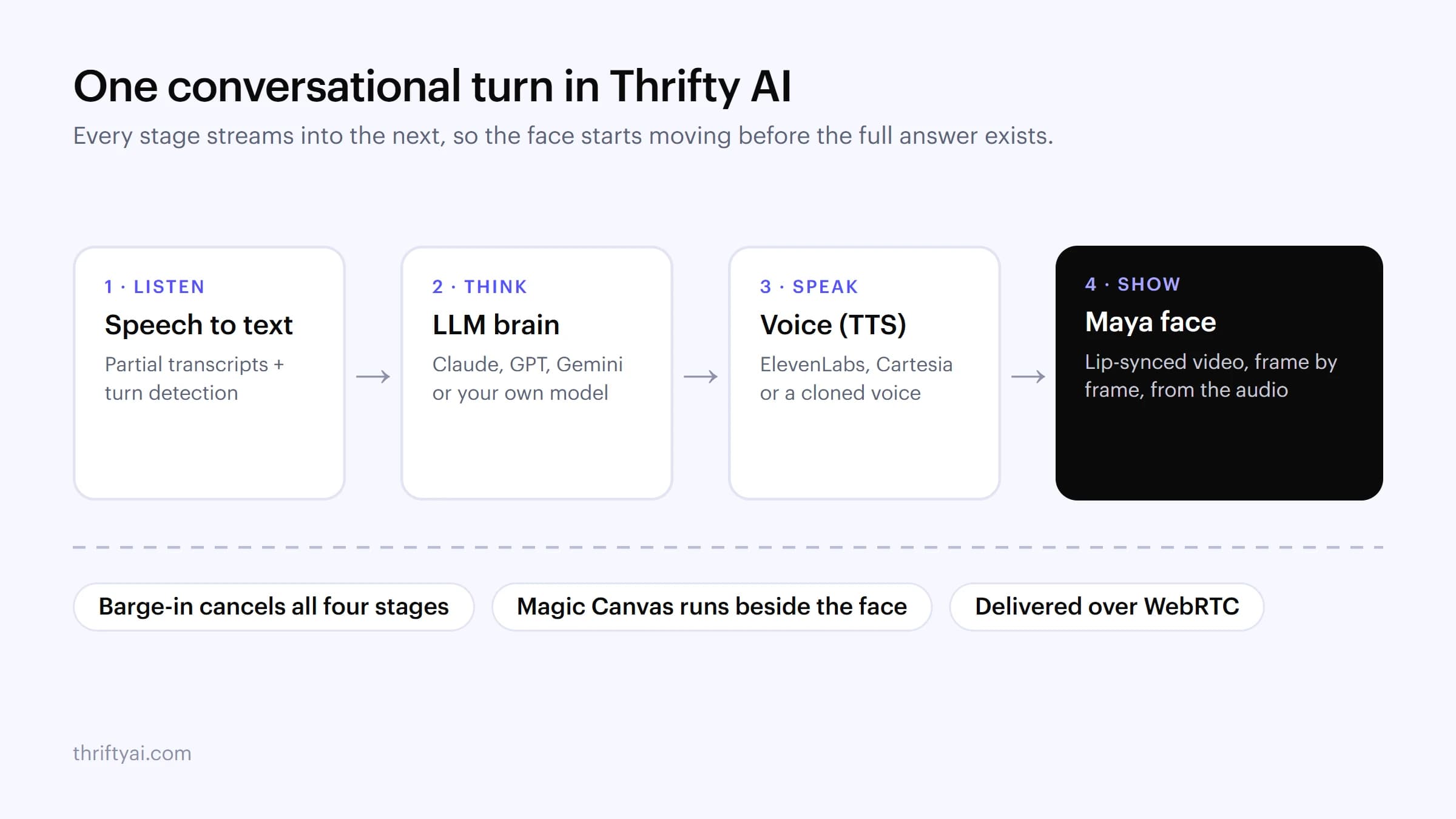
The pattern we recommend splits the brain into a fast talker and a slow doer:
- The talker is a fast model (Haiku 5.5 or Sonnet 5.5) that owns the conversation. It acknowledges the request immediately, asks clarifying questions and keeps the user company.
- The doer is Opus 5.5. It receives the task, plans, calls your tools (booking systems, CRMs, knowledge bases) and returns a structured result.
- The talker narrates progress in plain language ("I've found two flights, checking the hotel now") and asks for confirmation before anything irreversible.
- Magic Canvas shows the work: the flight options, the updated invoice, the form being filled, so the user can see progress as well as hear it.
Which jobs actually need Opus 5.5?
Most turns in most conversations don't. Greetings, policy questions and small talk are better served by a faster, cheaper model. Opus 5.5 earns its place when a request crosses systems or needs judgement over several steps.
| Scenario | Fast model alone? | Escalate to Opus 5.5 when… |
|---|---|---|
| Airline or hotel support | Status, baggage rules, opening hours | Rebooking across flights, hotels and refunds in one go |
| Banking | Balances, card freeze, branch info | Disputes that need several statements read and summarised |
| Healthcare admin | Appointment times, directions | Rescheduling a care pathway across clinics and insurers |
| Sales demo host | Product questions from the deck | Building a tailored proposal from CRM, pricing and case studies |
| L&D roleplay | Most of the roleplay itself | Scoring a 20-minute session against a detailed rubric afterwards |
What does it cost per conversation minute?
Token costs for AI humans are usually small next to the cost of video, but they are worth modelling. Here is an illustrative calculation for a support conversation with about six turns per minute. Each turn sends roughly 6,000 tokens of context (system prompt, knowledge snippets and history), of which about 5,500 are cached, plus 500 new tokens, and the model replies with about 120 tokens of speech.
| Model | Per turn (approx.) | Per conversation minute (approx.) |
|---|---|---|
| Claude Haiku 5.5 | $0.0002 | $0.001 |
| Claude Sonnet 5.5 | $0.0028 | $0.017 |
| Claude Opus 5.5 | $0.0055 | $0.033 |
The takeaway isn't that Opus is expensive. It is that routing matters. If Opus handles only the 10–20% of turns that involve real work, the blended brain cost stays close to the cheap model's, while the hard tasks get the strong model.
How do you set it up in Thrifty?
- In your AI human's settings, choose "bring your own LLM" and connect Claude through Anthropic's API, AWS Bedrock, Google Vertex AI or Azure, depending on where your data needs to stay.
- Set the conversational model to Haiku 5.5 or Sonnet 5.5 and register Opus 5.5 as a tool the talker can call for complex tasks.
- Define your tools (function calling) with clear names and strict schemas. Opus does its best work when tools are unambiguous.
- Write the talker's progress phrases and confirmation rules into the system prompt.
- For regulated deployments, combine Anthropic's zero data retention option with Thrifty's self-hosted face, voice and speech stack.
Frequently asked questions
Can Thrifty AI humans use Claude?
Yes. Thrifty supports bringing your own LLM, including Anthropic's Claude models via Anthropic's API, AWS Bedrock, Google Vertex AI or Azure.
Is Claude Opus 5.5 fast enough for a live AI human?
On its own it can feel slow in conversation, because extended thinking is always on and multi-step tasks take time. Pairing a fast talker model such as Haiku 5.5 or Sonnet 5.5 with Opus 5.5 as a background doer keeps responses immediate.
Which Claude model should I use for an AI human?
Use Haiku 5.5 for fast, simple turns, Sonnet 5.5 as the default brain for most personas, and Opus 5.5 for multi-step tasks that span several systems.
How much does Claude Opus 5.5 cost?
Anthropic lists Opus 5.5 at $4 per million input tokens and $20 per million output tokens, with cached reads at $0.20 per million and a Fast mode at $8 / $40.
Can I keep conversation data private?
Anthropic offers zero data retention for Claude, and Thrifty can run the face, voice and speech recognition on your own infrastructure, so sensitive conversations stay inside your environment.
Comparing model families? Read our companion post on pairing Thrifty with the latest GPT models.
![Lavender thumbnail reading Give Eleven v4 a face, with the ElevenLabs logo and a Thrifty Studios label, and a black-and-white AI human on a cream cloud with a caption reading [warmly] Welcome back!](/_next/image?url=%2Fimages%2Fblog%2Fthrifty-elevenlabs-v4-logo.webp&w=3840&q=75)